
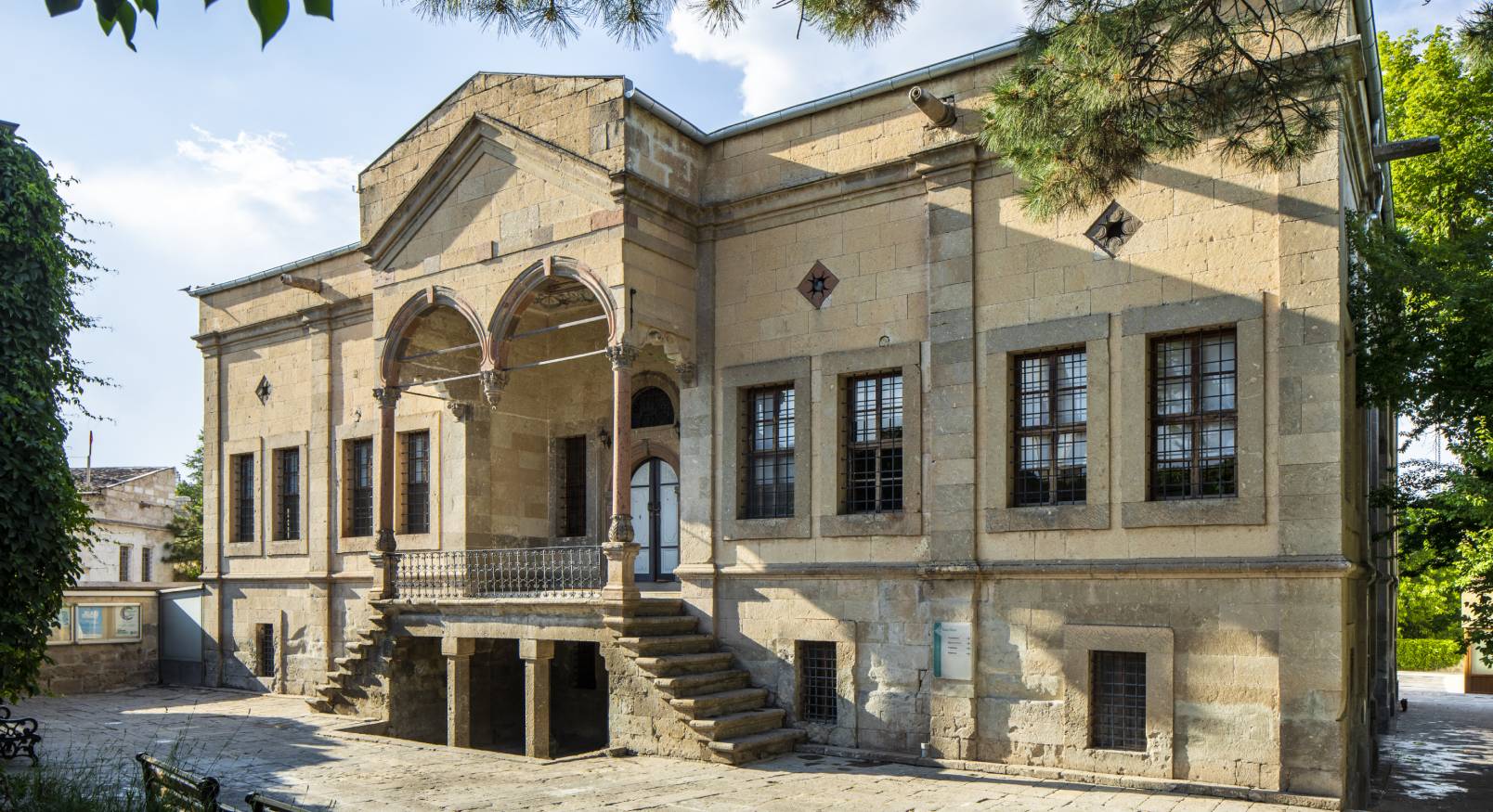
Mustafapaşa’s Mansions
Since the interests of the Rum community in Mustafapaşa, who became rich through trade, were merchants, especially in Istanbul, it is known that the Rum men were not masters and craftsmen. If we look at the magnificent mansions and decorations they built upon their return to their towns, it can be said that their knowledge of Istanbul very well and the development of their tastes and tastes may have been effective in this.
In Roides’ publication about the houses of Sinasos, it is stated that in a census conducted in 1924, there were two carpenters, a construction master, a plasterer, two whitewashers and a blacksmith in Mustafapaşa. Considering the number of buildings and residences that Ürgüp had at that time, the number of members of the construction guild named “Abraham Baba” in Ürgüp, which had around seven hundred members, was quite high. It is known that almost all the houses of the village were built by these masters. In the same publication, we come across information that Black Sea craftsmen also worked here in Mustafapaşa, and that some of these people, called Laz, married women from Sinasos and mixed with the community.
Despoina Bougioukmanou-Papandreou, who has been doing research on the history of Mustafapaşa for many years, is one of the researchers of our project, and is also the daughter-in-law of a Rum family that left the village with the population exchange, clarified the issue as follows: The surname of Despoina’s husband’s family, who settled on the Greek island of Euboea with the population exchange, is Lazopulu (Λαζόπουλου), meaning its Turkish equivalent and Lazoğlu. Within the scope of our research, this surname and its derivatives were frequently encountered. Despoina also states that, in the light of her research, she came across information that the Rum people in Mustafapaşa had good relations with the Rum community in Pontus. She states that many Rum construction workers came from the Pontus region to Mustafapaşa for seasonal work, and some of them settled in the village permanently and started families. Since these Rum people coming from Pontus were called “Laz” among the people, their surname remained “Lazoğlu”.
Considering the information above, most of the mansions were built by stone and mason masters from Ürgüp. This can be understood from the fact that the facade decorations of the houses in Ürgüp and Sinasos are very similar to each other. Again, from the above statements, it can be seen that, in addition to the stone masters from Ürgüp, Pontic masters also brought their artistic knowledge and talents to Sinasos. It is known that the Rum Sinasians who wanted to have a house built worked with the best masters of the period. The skill of the masters is evident in the fact that the houses are still standing intact today.
Although different masters and environments are decisive in the construction of mansions, when looking at the unique features of the mansions, it is felt that the opinions of those who ordered the buildings were also effective. The presence of magnificent mansions in the village, influenced by the capital, can be explained by the fact that the Rum community wanted to bring here copies of the mansions they saw in Istanbul. As a result, it can be said that these unique structures emerged, which are a common product of the Sinasian Rum people and their workers.
During the research carried out within the scope of the project, the existence of mansions owned by Muslims was also found. For example, one of them is Şenol Mansion, located in the area called “Miskin Neighborhood” during the Rum period, which constitutes the majority of Muslim houses in Mustafapaşa, that is, on today’s Baraj Street. During an interview we had with the owners of the house, Ergüvan Şenol stated that their house was built by a Rum master. This is just one of the indicators that the Muslim and Rum people, who lived side by side during the Ottoman period, were nourished by the same resources and built a common heritage.


