

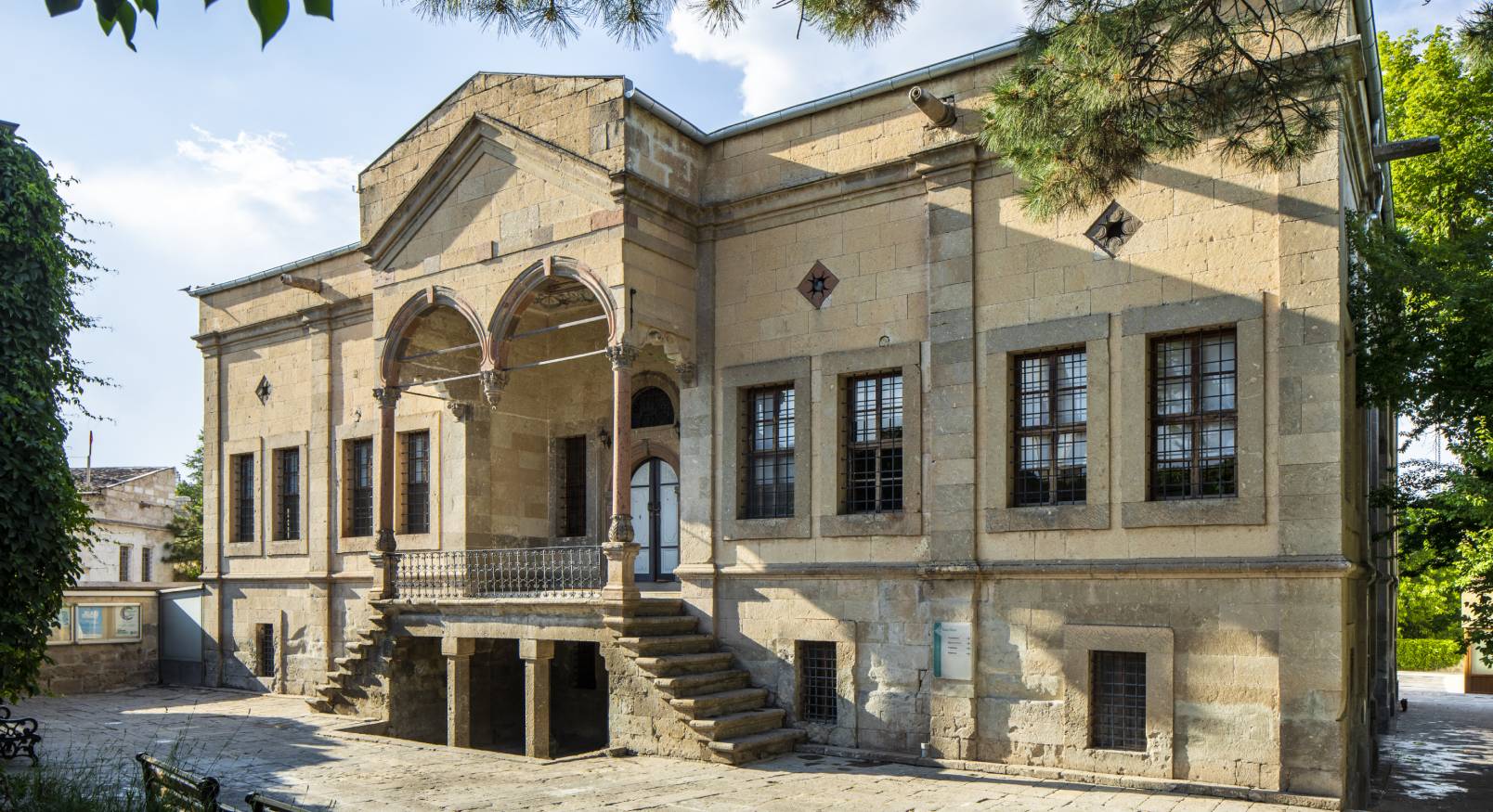
Mansions of Mustafapaşa
It is known that the Greek men in Mustafapaşa, who became wealthy through trade, were not skilled craftsmen, as their main interest was trading in Istanbul. Looking at the magnificent mansions and decorations they built upon their return to their town, it can be said that their familiarity with Istanbul and the development of their tastes and preferences may have been influential in this.
In Roides’ publication about the houses of Sinasos, it is stated that in a census conducted in 1924, there were two carpenters, one construction master, one plasterer, two painters, and one blacksmith in Mustafapaşa. Considering the number of buildings and houses that Ürgüp had at that time, the number of members in the “Abraham Baba” construction guild, which had about seven hundred members, was quite large. It is known that almost all the houses in the village were built by these masters. In the same publication, we come across information that Black Sea craftsmen also worked in Mustafapaşa, and that some of these people, referred to as Laz, married women from Sinasos and integrated into the local population.
Despoina Bougioukmanou-Papandreou, one of the researchers in our project who has been researching the history of Mustafapaşa for many years and who is also the daughter-in-law of a Greek family that left the village during the population exchange, clarified the issue as follows: Despoina’s husband’s family, who settled on the island of Euboea in Greece during the population exchange, had the surname Lazopulu (Λαζόπουλου), which translates to Lazoğlu in Turkish. We frequently encountered this surname and its derivatives during our research. Despoina also states that, in light of her research, she came across information indicating that the Greeks in Mustafapaşa had good relations with the Greeks in Pontus. She notes that many Greek construction workers came to Mustafapaşa from the Pontus region to work seasonally, and some of them settled permanently in the village and established families. Because these Greeks from Pontus were called “Laz” by the locals, their surname remained “Lazoğlu”.
Looking at the information above, most of the mansions were built by stonemasons and bricklayers from Ürgüp. This is also evident from the fact that the facade decorations of the houses in Ürgüp and Sinasos are very similar. Again, from the above statements, it is seen that, in addition to the stonemasons from Ürgüp, craftsmen from Pontus also brought their artistic knowledge and skills to Sinasos. It is known that the Greek inhabitants of Sinasos who wanted to build houses worked with the best craftsmen of the time. The skill of the craftsmen is evident in the fact that the houses are still standing strong today.
Although different craftsmen and environments were decisive in the construction of the mansions, when looking at the unique features of the mansions, it is felt that the opinions of those who commissioned the buildings also had an influence. The presence of magnificent mansions in the village, influenced by the capital city, can be explained by the fact that the Greeks wanted to bring here copies of the mansions they saw in Istanbul. In conclusion, it can be said that these unique structures emerged as a joint product of the Greeks of Sinasos and their workers.
During the research conducted within the scope of the project, the existence of mansions owned by Muslims was also encountered. For example, one of them is the Şenol Mansion, located on what is now Baraj Street, in the area known as “Miskin Mahalle” during the Greek period, which constitutes the majority of Muslim houses in Mustafapaşa. During an interview with the owners, Ergüvan Şenol stated that their house was built by a Greek master craftsman. This situation is just one of the indicators that the Muslim and Greek populations who lived side by side during the Ottoman period drew from the same resources and built a common heritage.


