

Water has had a very important place in the lives of Turks since pre-Islamic times. Many beliefs based on water cult emerged among the ancient Turks. With Islam, water, one of the most important requirements of worship, has become a vital resource that should not be wasted. As well as the emergence of water around beliefs, the fact that water is one of the basic needs of life has increased its importance. Meeting the water need by the state or philanthropists enabled the construction of different types of fountain structures in different periods.
Çeşme, which means “çeşm” in Persian and “eye-water source” in Turkish, is expressed with Arabic “ayn”. Among the public, fountain structures are also called “eye, eye, spring”. These water structures, which entered Turkish as “fountain” under the influence of the Persian language, are used to mean water source.
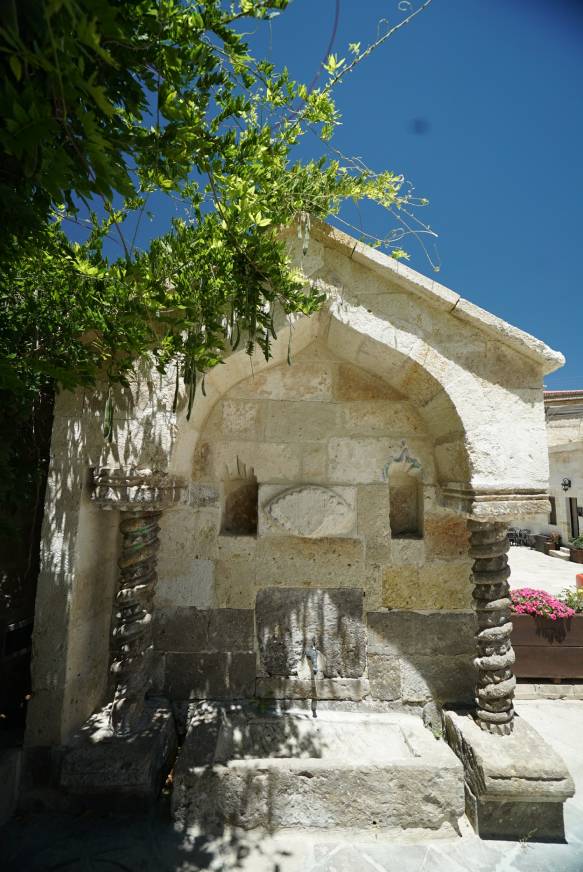
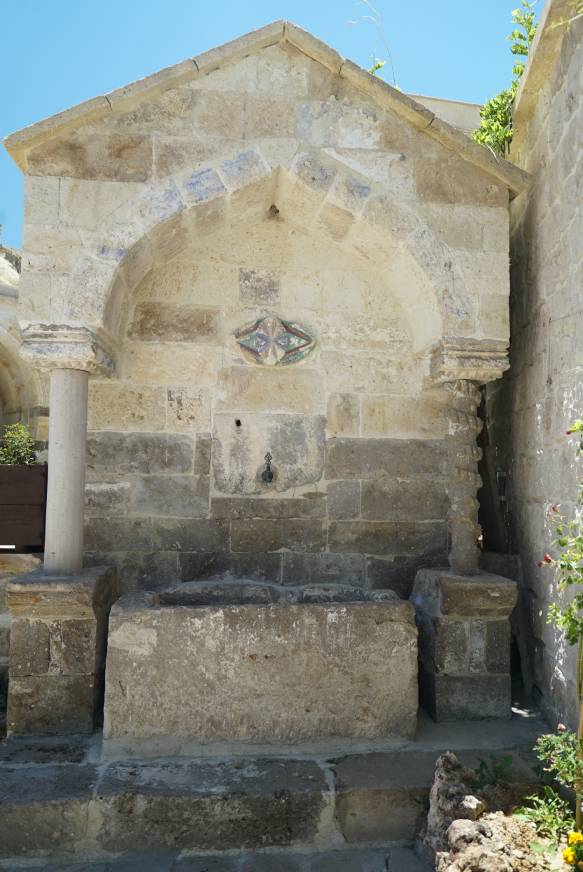
Traditional Turkish fountains generally consist of a ringed mirror stone in an arched niche and a basin placed on the ground in front of it. In addition to fountains designed on a single facade and with a single tap, there are also fountains with more than one tap distributed on other facades in open-circuited fountains.
When we look at the historical fountains in Ürgüp as well as the fountains in Mustafapaşa, it is understood that functionality is prioritized in these structures and aesthetic concern is relegated to the background. The decoration was applied within the framework of a specific and limited program. Among these, the fountain located in the courtyard of the Serafim Hotel today has a more intense ornamentation program than the others.
Some Important Fountain Structures That Can Be Seen in Mustafapaşa Today
Camii Kebir Mustafa Pasha Fountain:
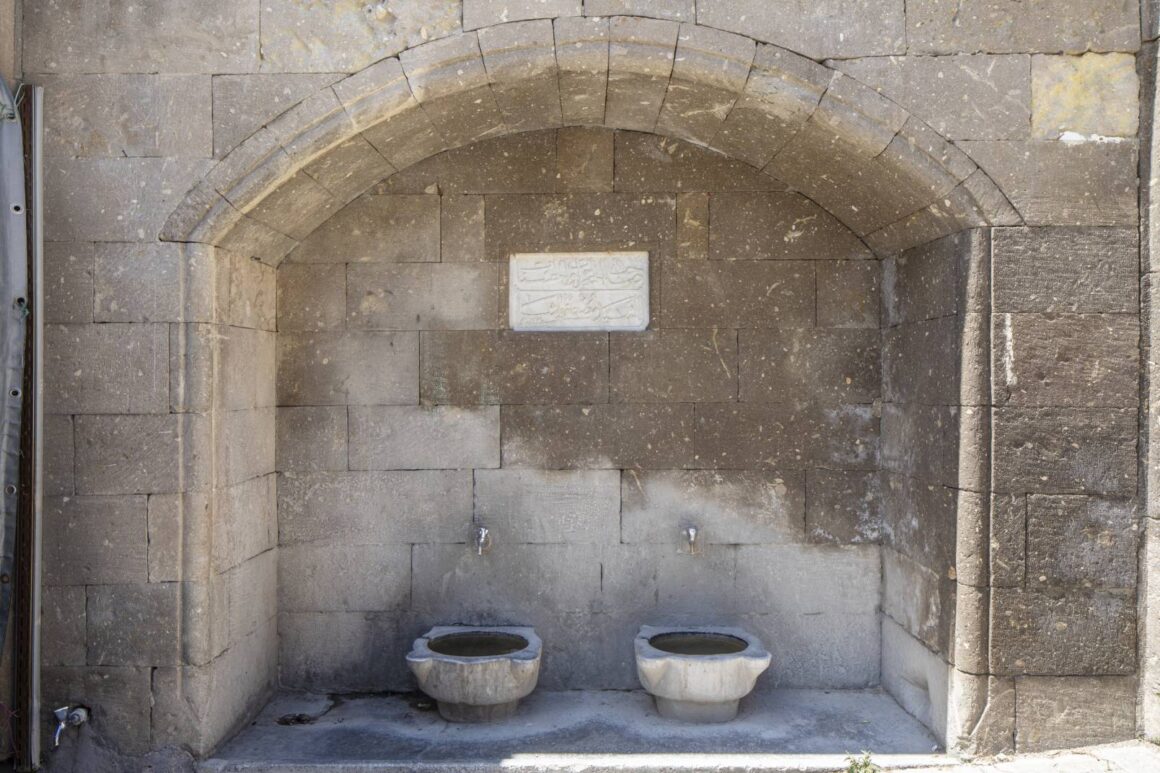
The fountain, also known as Seyyid Mustafa Pasha Fountain, is still operational today. Today, the mosque is located to the south of Kebir. The fountain was removed from its original location and moved to its current location during the widening of the road between the madrasah and the mosque. According to the marble inscription in the middle of the niche facade, it was built by Mustafa Pasha in 1804-1805. The inscription contains the Arabic inscription “صاحب الخیرات والحسنات سید مصطفی پاشا ۱۲۱۹”. The inscription is written in relief technique and in celi-sülüs calligraphy. The single-arched and single-faced fountain was built from smooth cut basalt stone. The fountain niche is surrounded by a low arch with profile moldings on the surface. This arch rests on piled pillars with pillar-shaped edges. There is a trough in the shape of a basin under the two taps that were connected later.
Upper Neighborhood Fountain:
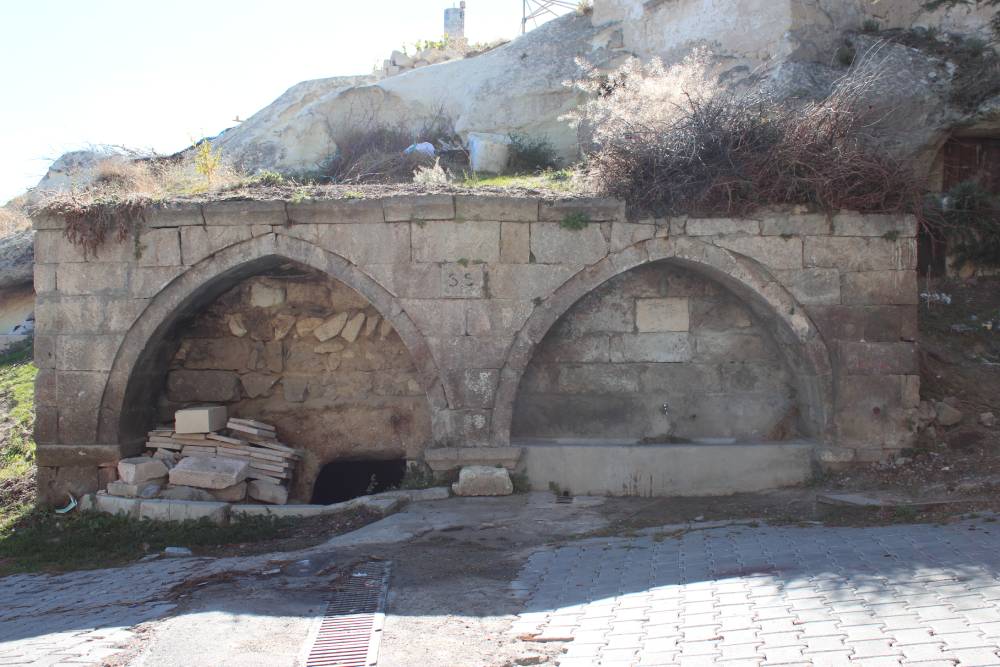
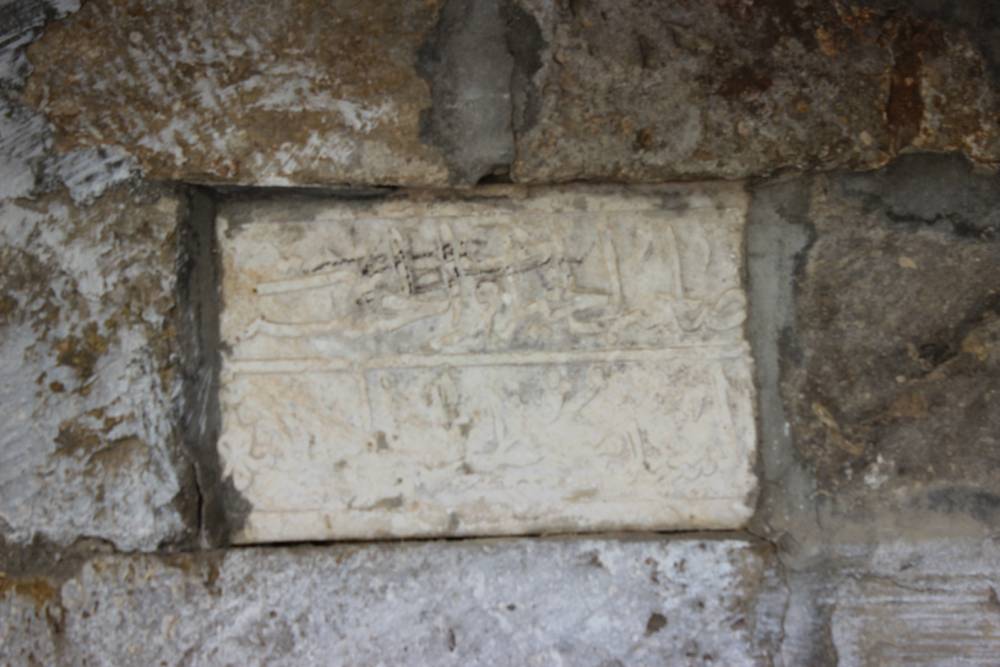
The fountain, which is still operational today, is located on the left of the hill on the way from Davutlu Mevkii to the Cappadocia Art and History Museum via Dere Street and diagonally opposite the entrance gate of the Sipahi Mosque. According to the marble inscription in the middle of the niche facade, it was built by Mustafa Pasha in 1804-1805. The inscription is written in relief technique and in celi-sülüs calligraphy.
The fountain, made entirely of smooth cut stone and leaning on the rock behind it, has two arches and a single façade. Pointed arches surround the fountain niches. The arches sit on piled pillars in the middle and on the sides. The concrete trough that continues along the niche was added here later. While the niche façade in the south of the fountain is stronger, the north one is in poor condition.
Square Fountain:
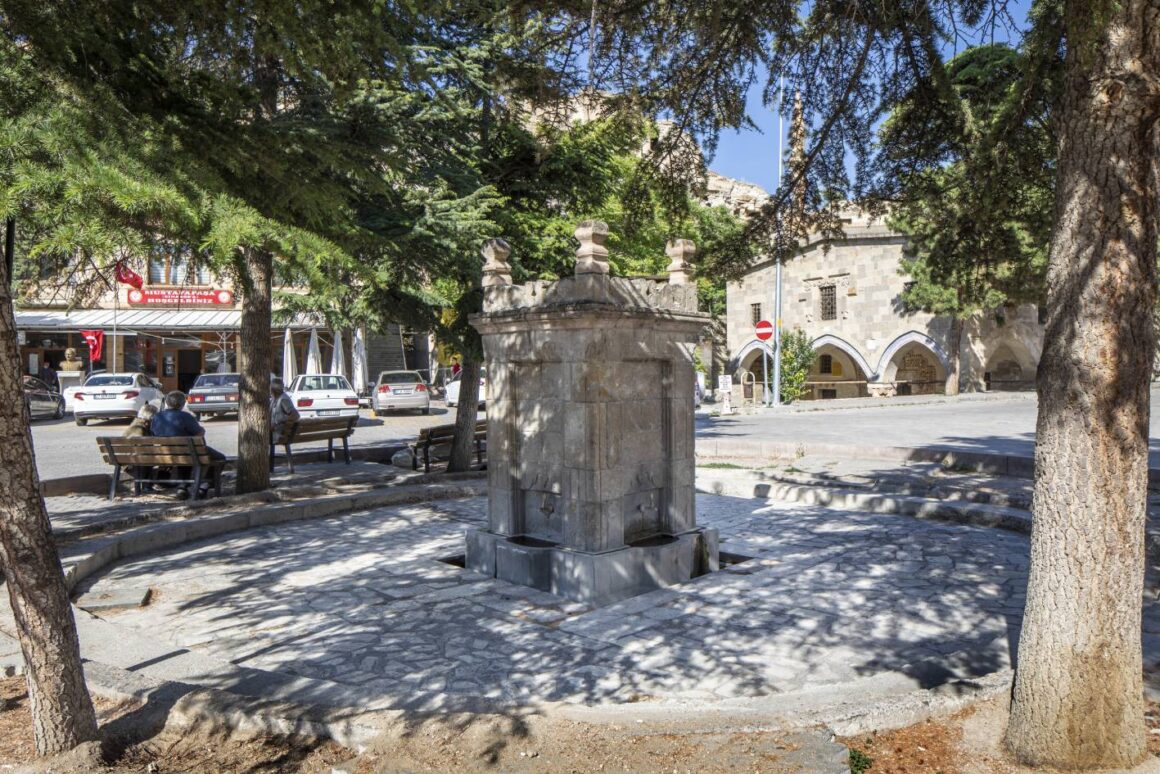
The fountain, which is actively used today, is located in the middle of Cumhuriyet Square. Although the exact date is not known since it does not have an inscription, according to the statements of the village people, the fountain was built in 1951. It can be seen that the fountain is similar to the Lala Fountain in Ürgüp (1812-1813) in terms of the number of facades.
The fountain is extremely suitable as a square fountain in terms of its location and multi-faceted nature. The taps of the fountain are located in niches surrounded by profile mouldings. There are relief palmettes and curved branch motifs on the upper part of the taps. At the top of the fountain, a profile molding eaves can be seen surrounding the four facades. The “S” and “C” curved crowns on the eaves, repeating on every side, add dynamism to the fountain.
Sources:
Aydin, R. (2020). Ürgüp Fountains. Kayseri: ID Publications.
Sözen, M. and Tanyeli, U. (2012) Dictionary of Art Concepts and Terms. Istanbul: Remzi Bookstore.


